
There is a lot
behind that smile.
Two doors, a fixed roof, and an open sweep of side glass. Meet the 1957 Chevrolet Bel Air Sport Coupe. Look closer: the hood rockets are decorative, the vents above the headlights are not, and the fluted quarter insert identifies the Bel Air trim treatment shown.
This guide uses an illustrative factory configuration: model 2454, a 283-cubic-inch 185 gross hp two-barrel V8, Powerglide and color combination 810. The photographs show a separate surviving car whose paint code and drivetrain are not authenticated here. Read the body from the roof down, then follow the air behind the headlights. Small distinctions can change which car you think you are looking at.
An open view. A telling detail.
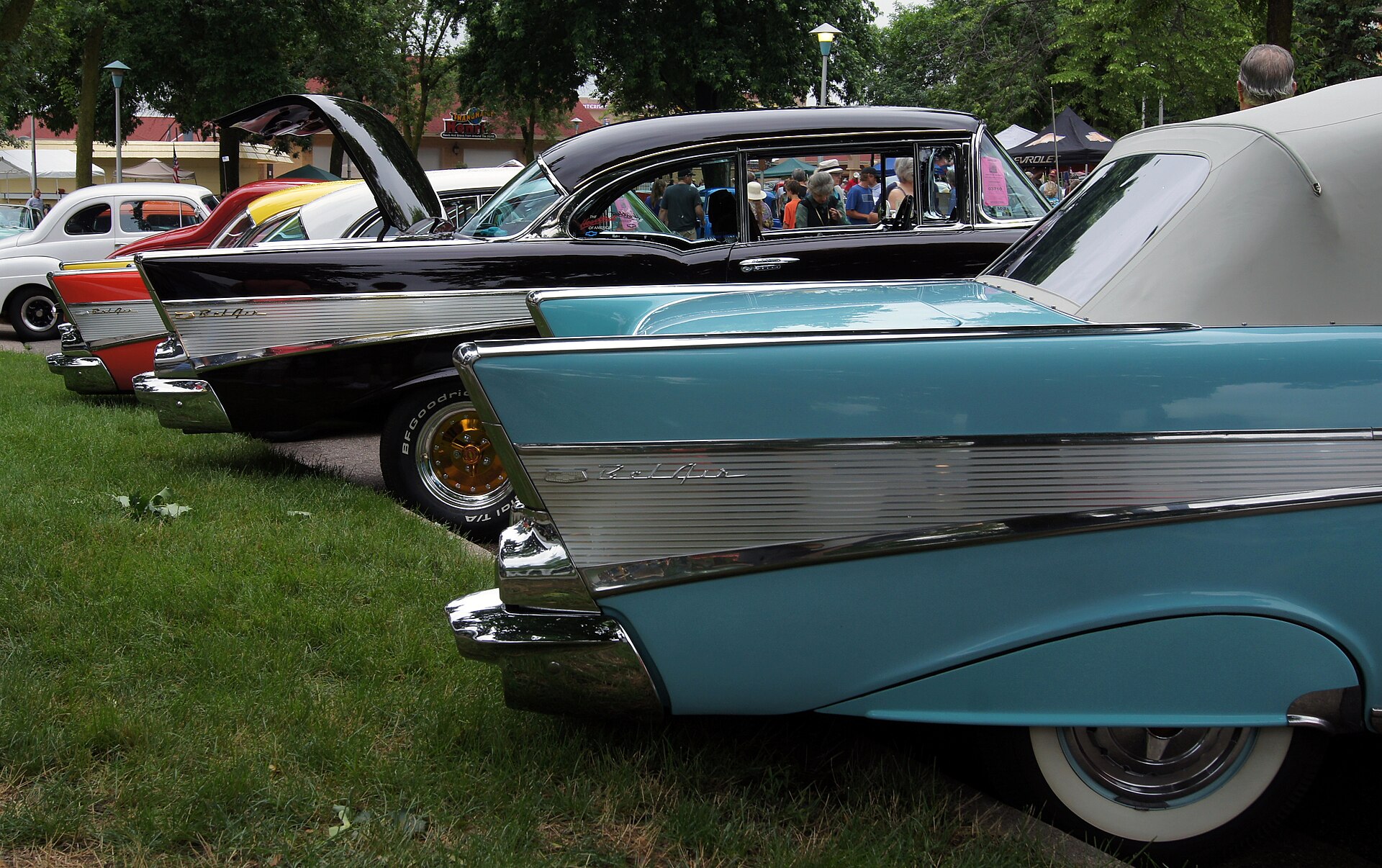
A pillarless roof does not make a ’57 a Bel Air. Chevrolet also offered a Sport Coupe in the 210 series. Both have the hardtop opening; the Bel Air treatment adds a shallow-fluted aluminum quarter insert. The 210 carries its outline without that panel. Read body and trim as separate clues.
The two-door post sedan has a fixed center pillar dividing the side-window opening. Chevrolet called the pillarless two-door a Sport Coupe, model 2454, and listed it for six passengers. “Hardtop” describes a fixed roof; it does not mean the roof comes off.
Four doors. Still a hardtop.
The Bel Air Sport Sedan, model 2413, has four doors and no fixed center window pillar. It is not the four-door post sedan.
Body and trim schematics share a wheelbase scale. Simplified outlines are not restoration templates or color references.
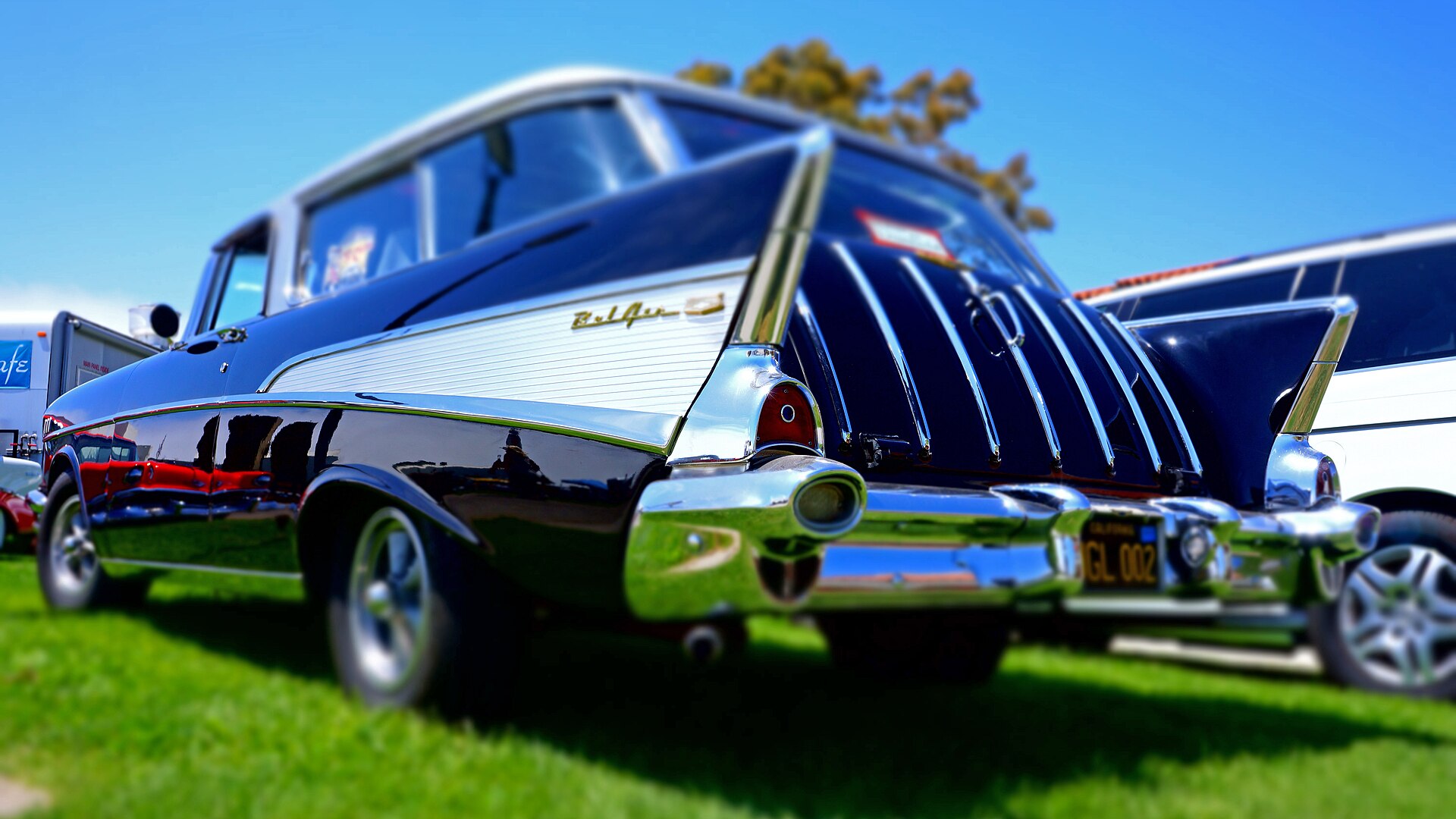
Bel Air was a seven-model series: Sport Coupe, two-door sedan, four-door sedan, Sport Sedan, convertible, Nomad two-door wagon and four-door wagon. The comparison above separates its hardtop bodies from the post sedans.
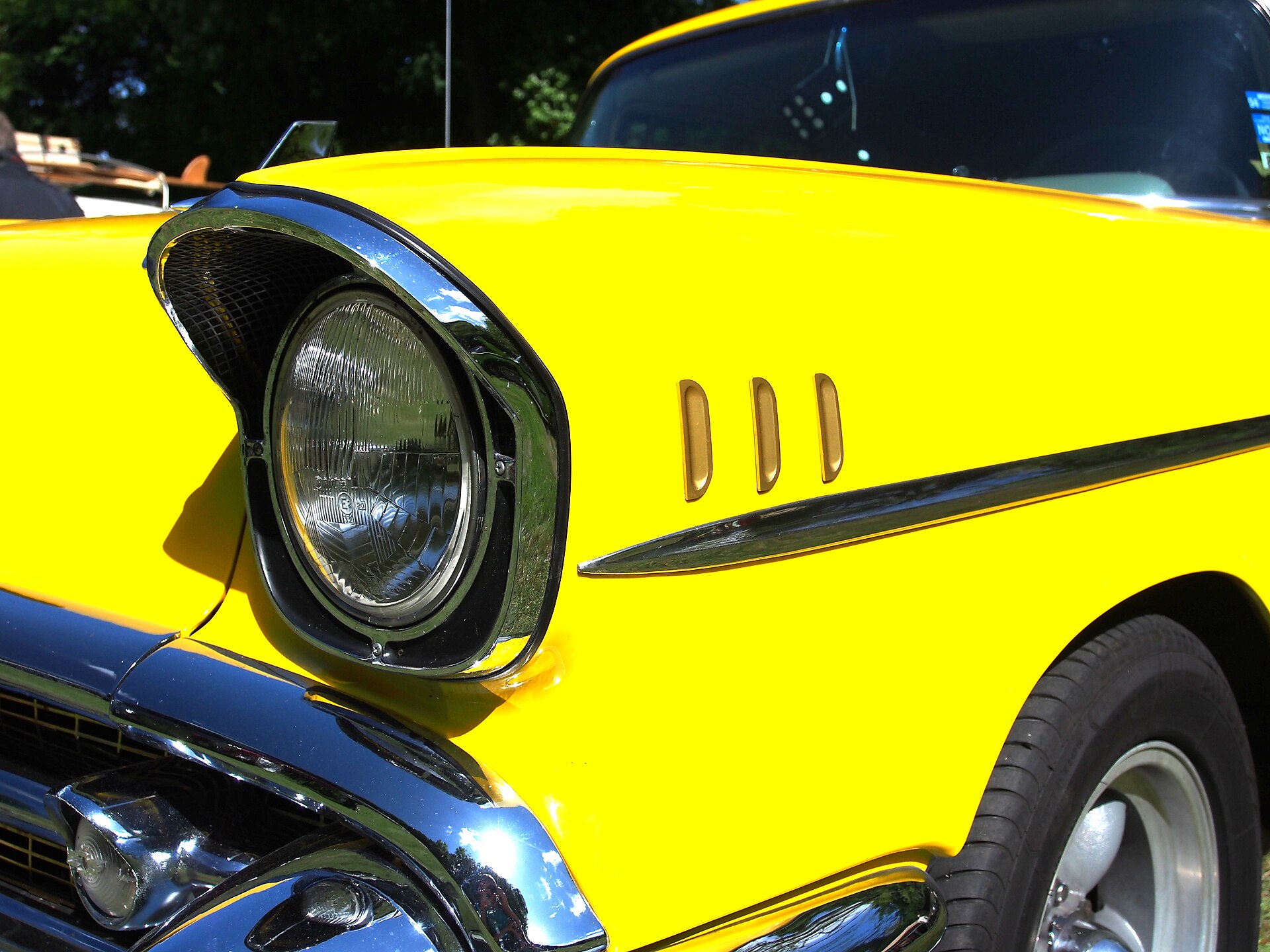
The 210 is not simply a Bel Air with a missing badge. Its factory trim treatment includes a bright-anodized grille screen and an outlined rear-quarter area without the Bel Air’s fluted aluminum insert. The 150 also uses the bright grille treatment. Both lower series use painted indentations where the Bel Air has its three gold-anodized front-fender side ornaments. Read a group of details rather than letting one replacement emblem settle the question.
Beyond the two-door.
Model 2429 is the two-door Nomad wagon, listed for six passengers. Chevrolet also offered a four-door Bel Air wagon, model 2409. “Bel Air wagon” and “Nomad” are not interchangeable names; the Sport Sedan comparison above supplies another useful body distinction.
Counting the range prevents another small confusion. Chevrolet’s engineering booklet lists seven Bel Air models, eight in the 210 series and four in the 150 series. That makes nineteen full-size passenger models; adding Corvette brings the booklet’s passenger-model count to twenty. The convertible is separately listed for five passengers. None of those counts describes the number of Sport Coupes built.
Sources & notes
Factory documents establish specifications and what Chevrolet claimed. They do not authenticate an individual surviving car.
- F01E pp. 10–12; B scan 03. Chevrolet Engineering Features · October 1956
- F02E pp. 10–13. Chevrolet Engineering Features · October 1956
- F03E pp. 10,14–19; S scan 17. Chevrolet Engineering Features · October 1956
- F04E pp. 10–11; B scan 02. Chevrolet Engineering Features · October 1956
- F05E pp. 12–13. Chevrolet Engineering Features · October 1956
- F06E p. 10. Chevrolet Engineering Features · October 1956
- F13E p. 24; S scan 26. Chevrolet Engineering Features · October 1956
- F14E p. 25. Chevrolet Engineering Features · October 1956
- F16E p. 26. Chevrolet Engineering Features · October 1956
- F17E p. 26. Chevrolet Engineering Features · October 1956
- F23E pp. 26,71. Chevrolet Engineering Features · October 1956
- F24E p. 44; S scan 17. Chevrolet Engineering Features · October 1956
A little theater. A little engineering.

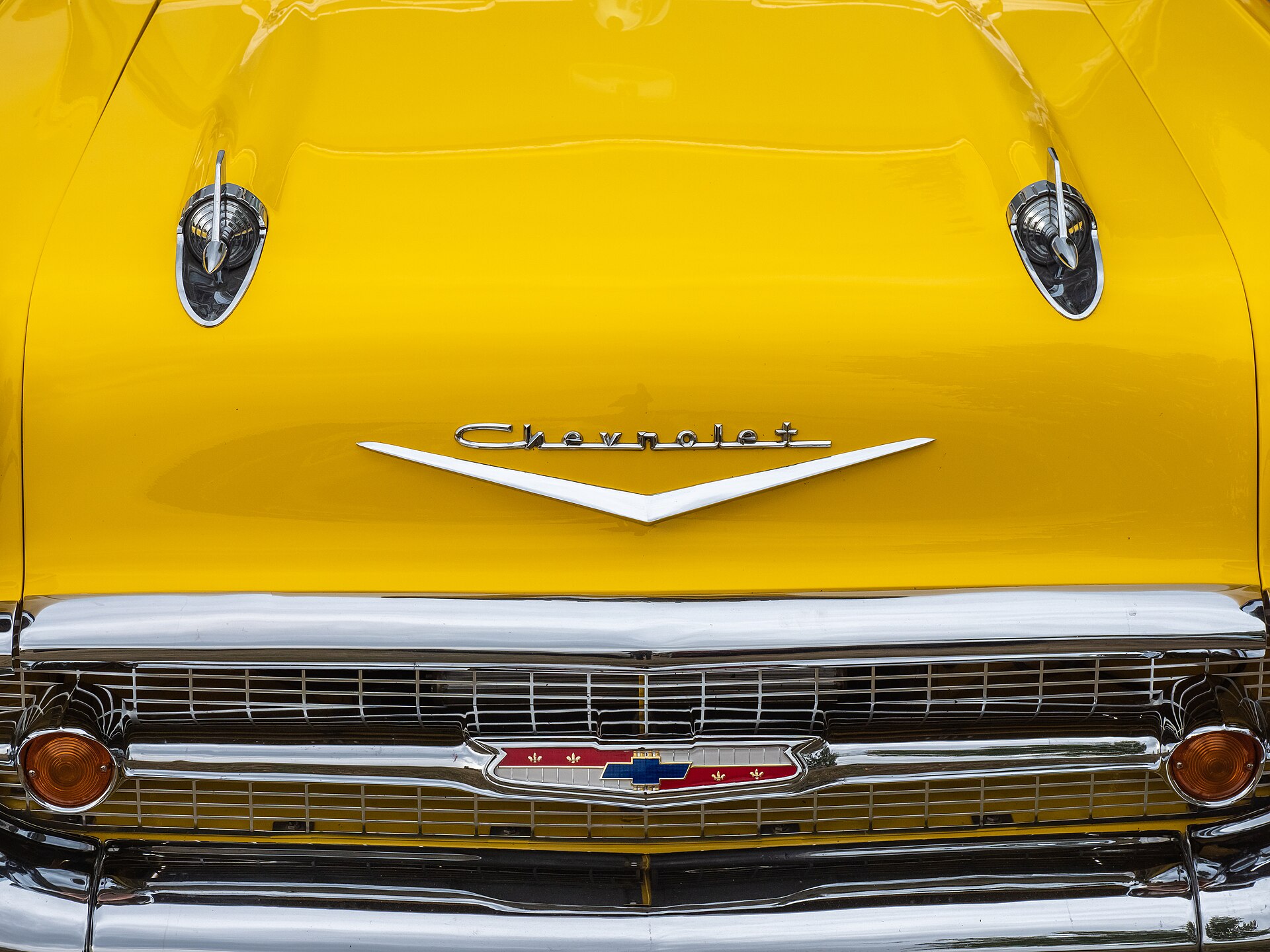
The openings that look fastest are the ones that do nothing. Chevrolet’s twin hood ornaments simulate air intakes. The working ventilation inlets sit above each headlamp; the lower mesh continues the appearance but is decorative.
Where would you put the gas?
The cap hides behind a hinged door in the left rear fender, just above the taillight. The lamp stays in place.
The air takes the long way.
Behind the front sheet metal, the air takes a detour. It travels under the fenders toward outlets at the sides of the dash. A dip in the duct and a drain deal with water; this is not a straight open pipe aimed at the passengers. Removing the former cowl plenum helped Chevrolet lower the cowl center by about an inch.
Chevrolet’s engineering booklet reported 746 cubic feet per minute at 60 mph, against 611 cubic feet per minute for 1956. Those are the manufacturer’s period comparison figures. They are not our measurements, and they are not a promise about airflow in a surviving car with decades of repairs behind it.
Separate the finishes. The Bel Air grille screen is gold-anodized aluminum. The hood V indicates a V8, not a particular displacement. Three gold-anodized D-shaped ornaments sit on each front-fender side; they are decorative. At the rear, the wider Bel Air fin-crown molding runs from the rear window toward the taillight. The reading-room archive explains why bumper-tip appearance alone is not an originality test.
The rear-quarter insert is shallow-fluted anodized aluminum; its nameplate and crest receive the gold finish. Making the entire panel gold loses the distinction. Full wheel covers belong in the Bel Air picture, too. The shift from 15-inch to 14-inch standard wheels was accompanied by a tire-size change from 6.70 × 15 to 7.50 × 14.
Sources & notes
Factory documents establish specifications and what Chevrolet claimed. They do not authenticate an individual surviving car.
- F12E p. 24. Chevrolet Engineering Features · October 1956
- F13E p. 24; S scan 26. Chevrolet Engineering Features · October 1956
- F14E p. 25. Chevrolet Engineering Features · October 1956
- F15E p. 24. Chevrolet Engineering Features · October 1956
- F16E p. 26. Chevrolet Engineering Features · October 1956
- F17E p. 26. Chevrolet Engineering Features · October 1956
- F18E p. 23. Chevrolet Engineering Features · October 1956
- F19E pp. 23,45–46. Chevrolet Engineering Features · October 1956
- F20E pp. 45–46. Chevrolet Engineering Features · October 1956
- F21E p. 45. Chevrolet Engineering Features · October 1956
- F22E p. 45. Chevrolet Engineering Features · October 1956
- F23E pp. 26,71. Chevrolet Engineering Features · October 1956
- R13A p. 88, accessory 987578. Open the cited document
- R16Owner's manual p. 6, GAS CAP paragraph; exact locator excerpt: `left rear fender, just above the tail light.` Illustration shows a distinct door above the lamp. Open the cited document
Blue, with a little room to dream.
Factory combination 810 puts India Ivory on the roof and pillars, with Larkspur Blue on the rest of the painted exterior and wheels. The aluminum quarter insert keeps its own finish. Follow those separate surfaces in the explorer below.
Inside, the blue changes. The painted upper/lower instrument panel and listed garnish group are Harbor Blue; the steering wheel, instrument cluster and listed control housings are Larkspur Blue. The center instrument-panel and radio-cover panels are bright metal. Medium/dark blue upholstery completes the chart pairing.
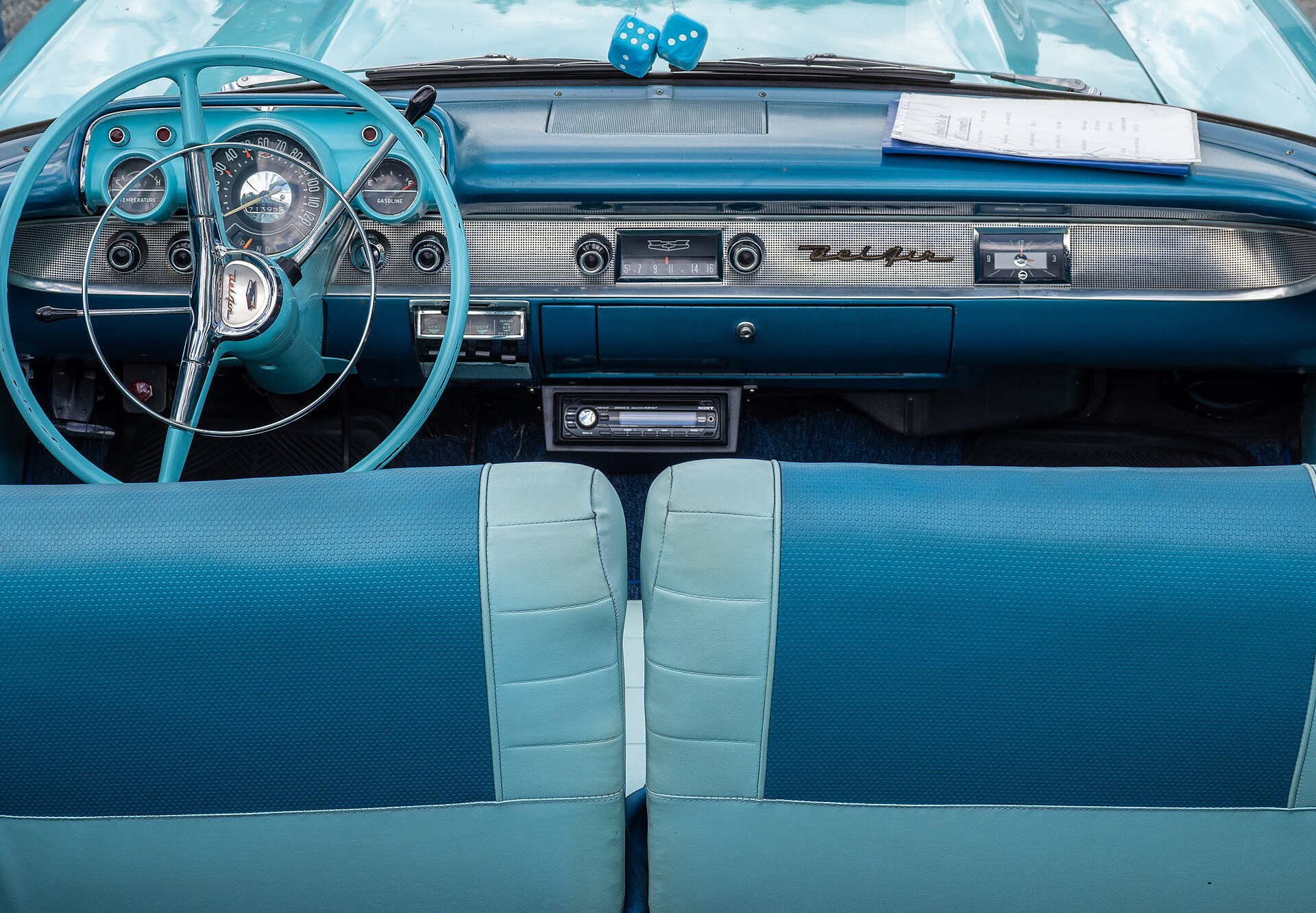
Carry the color inside.
- Painted upper / lower panel & listed garnish group
- Harbor Blue
- Center instrument panel & radio-cover panel
- Bright metal
- Steering wheel, cluster & listed control housings
- Larkspur Blue
- Upholstery
- Medium / dark blue
- Road wheels
- Larkspur Blue
Which painted surfaces does the chart group together?
The first painted group includes the upper/lower instrument panel, garnish moldings, door-lock rod knobs, horn-cover panel and ashtray faceplate. The other group names the steering wheel, instrument cluster, turn-signal housing and gearshift-control housing. The bright-metal footnote applies to all series 2400 cars.
The factory table lists fifteen two-tone pairings. This explorer coordinates two complete combinations, 810 and 811, including their interiors. India Ivory over Tropical Turquoise is a different choice from 810. The full exterior table remains in Sources & notes; screen colors are editorial approximations, not paint-matching references.
The parts catalog gives Duco 253-58458 for India Ivory and 253-90114 for Larkspur Blue. These are historical formulation identifiers, not RGB values. A blue photograph can help you see color placement; it cannot make your screen a factory paint chip.
A miniature is another place to practice looking. Check the center pillar before the color, then check the rear-quarter treatment. Round2’s AMT1079 instruction download is identified as a 1957 Chevy Bel Air hardtop. That document is useful for identification; its webpage date does not tell you when the original tooling first appeared. Keep the body-style question separate from the history of a particular kit.
Sources & notes
Factory documents establish specifications and what Chevrolet claimed. They do not authenticate an individual surviving car.
- F40M p. 1133; S scan 31; E p. 25. Master Parts Catalog · paint chart, p. 1133
- F41S scan 31 footnote; E p. 25. Chevrolet Specifications · dated 1956–57 sheets
- F42S scan 31. Chevrolet Specifications · dated 1956–57 sheets
- F43S scan 31. Chevrolet Specifications · dated 1956–57 sheets
- F44M p. 1133. Master Parts Catalog · paint chart, p. 1133
- F62R2 manufacturer page. Round2 · AMT1079 instruction download
- R15Specifications scan 31, series 2400 two-color table: rows 3, 4 and 5, headers of columns 4/5; footnote: `Instrument panel center and radio cover panel are bright metal in all Series 2400 cars.`. Open the cited document
- R21Master Parts Catalog p. 1133, rows 807/810 India Ivory and 808 Imperial Ivory. These are formulation identifiers, not exterior combination numbers or digital color values. Open the cited document
- R24Master Parts Catalog p. 1133, complete rows 810 and 811; other model rows are not used for the selector. Open the cited document
The full factory two-tone table, series 2400. First color: roof and pillars. Second color: remainder of exterior.
| Roof / pillars | Body |
|---|---|
| India Ivory | Onyx Black |
| Imperial Ivory | Inca Silver |
| Larkspur Blue | Harbor Blue |
| India Ivory | Larkspur Blue |
| India Ivory | Tropical Turquoise |
| Surf Green | Highland Green |
| India Ivory | Surf Green |
| India Ivory | Coronado Yellow |
| Onyx Black | Colonial Cream |
| India Ivory | Colonial Cream |
| India Ivory | Canyon Coral |
| Adobe Beige | Sierra Gold |
| India Ivory | Matador Red |
| Imperial Ivory | Dusk Pearl |
| Colonial Cream | Laurel Green |
A dashboard full of possibilities.
What is that lens
on the dashboard?
Chevrolet’s installation sheet identifies a traffic-light viewer: a clear lens on a short adjustable arm at the instrument panel. The separate patent source explains the general optical idea—redirecting an overhead signal into view. It does not establish that Chevrolet used that patented design.
Chevrolet’s sheet identifies accessory 987499. Its adjustable lens arm meets a clevis secured by a machine screw; a threaded mounting passes through the panel and is retained underneath. The diagram beside this text makes those pieces visible without turning the illustration into a fitting template.
Documented parts shown
- Lens, adjustable arm and clevis
- Machine screw and threaded mounting
- Retaining washers and nut
Major checkpoints, not an all-parts inventory or a fitting procedure.
Compare the full installation sheet ↗The last instruction asks the installer to adjust the lens for minimum lines. The sheet covers passenger cars and trucks, with a separate truck positioning sketch. The existence of a Chevrolet accessory sheet does not make the viewer standard Bel Air equipment or an object exclusive to the Sport Coupe.
Let the light change the lights.
The Autronic Eye automatically controls headlamp beams. Its dashboard head is a phototube unit connected to other equipment. It is distinct from the clear optical traffic-light viewer. The original scanned index and installation sheet both use Autronic Eye.
A small dashboard housing does not demonstrate a complete working system. The installation record also shows an amplifier, power relay, foot switch and connecting wiring. Chevrolet directed the dealer to attach an owner-instruction tag to the light switch. Compare the whole documented installation when considering what a surviving car actually has.
Documented parts shown
- Phototube, mounting pad/plate and hardware
- Amplifier, power relay and connecting harnesses
- Combination foot switch
Major checkpoints, not an all-parts inventory or a fitting procedure.
Compare the full installation sheet ↗Sources & notes
Factory documents establish specifications and what Chevrolet claimed. They do not authenticate an individual surviving car.
- R03AB p. 28; A p. 38. Open the cited document
Find a station. Keep your favorites.
Press the Wonder Bar and the radio seeks a station. Chevrolet describes an electronic automatic tuner operated by a selector bar, plus five pushbuttons for favorite stations. Finding a station while traveling and returning to a chosen one are separate conveniences. The dashboard face is only part of the installation.
Do not apply every radio claim to every set. On the facing page, Chevrolet describes a different Deluxe Pushbutton Radio with a transistorized circuit. The engineering booklet credits a transistor with eliminating a power-supply transformer and mechanical vibrator. Neither passage makes every 1957 Chevrolet receiver an all-transistor Wonder Bar. Identify the particular radio first, then use the matching operating or service document.
Documented parts shown
- Receiver, speaker, support brace and face hardware
- Antenna and speaker leads; documented suppression parts
- Separate power supply for the signal-seeking receiver
Major checkpoints, not an all-parts inventory or a fitting procedure.
Compare the full installation sheet ↗Sources & notes
Factory documents establish specifications and what Chevrolet claimed. They do not authenticate an individual surviving car.
- R04AB pp. 8–9. Open the cited document
- F37E p. 88. Chevrolet Engineering Features · October 1956
Two masts. More than one story.
Two rear antennas make a memorable silhouette, but a matched pair is not proof of a standard factory arrangement. Chevrolet documented manual left-rear antenna 987605 and electric right-rear antenna 987606. The accessory brochure says the electric version rises and lowers from an instrument-panel switch. It presents the manual and electric rear antennas as distinct choices.
What does each mast connect to? Compare a surviving installation with its diagram and paperwork. The factory documents establish the available pieces and specified positions, but not a universal explanation for every twin-antenna car seen today.
Sources & notes
Factory documents establish specifications and what Chevrolet claimed. They do not authenticate an individual surviving car.
- F36A pp. 153–154; E p. 88. Chevrolet Accessories Installation Manual · 1957
- R07AB p. 11. Open the cited document
A small luxury, neatly tucked away.
The tissue dispenser is a small convenience with a surprisingly precise installation. Chevrolet’s drawing places it beneath the instrument panel, beside the ashtray opening. Its bracket attaches to the panel’s lower flange with bolts, lockwashers and nuts. The accessory brochure says it holds a full box of standard tissues. It was an actual storage accessory, not an extra radio component.
A polished lid tells less than the way its bracket meets the panel. The drawing establishes the intended installation of accessory 987512. Dating a surviving dispenser, or showing that it was fitted when the car was new, requires other evidence.
Sources & notes
Factory documents establish specifications and what Chevrolet claimed. They do not authenticate an individual surviving car.
- R05A p. 79; AB p. 24. Open the cited document
The spare steps outside.
Chevrolet’s Continental wheel carrier moves the spare-wheel display outside the normal trunk silhouette. The installation cover shows the wheel upright behind the car, enclosed by a cover and surrounded by an extended rear-bumper arrangement. This is more than a decorative circle placed on the trunk lid.
Chevrolet promoted continental appearance and additional trunk space. Those are the brochure’s selling points, not a luggage-capacity measurement here. Compare the entire carrier and bumper installation. The catalog establishes availability, without authenticating every fitted carrier seen today.
Documented parts shown
- Covered spare and accessory bumper arrangement
- Adapter, spacers, bumper brackets and ends
- Documented jack-storage arrangement
Major checkpoints, not an all-parts inventory or a fitting procedure.
Compare the full installation sheet ↗Sources & notes
Factory documents establish specifications and what Chevrolet claimed. They do not authenticate an individual surviving car.
- R06A p. 62; AB p. 5. Open the cited document
A separate shoulder harness.
Was this among Chevrolet's offered accessories?
The period document has the answer.
Read the documented answer
Page 14 offers the shoulder harness for use with seat belts.
See the original illustration ↗Wash with your foot.
The foot-operated washer sprays and starts the blades when the lever is depressed. Releasing it returns them to the parked position.
Pedal released · blades parked
Conceptual sequence, not measured timing or sweep geometry.Sources & notes
Factory documents establish specifications and what Chevrolet claimed. They do not authenticate an individual surviving car.
- R19Accessory brochure p. 18, FOOT-OPERATED TYPE paragraph, both sentences. Operational sequence confirmed; timing, sweep angles and internal mechanism are not specified here. Open the cited document
The seat tilts as it slides.
The owner's manual says the front seat tilts as it slides forward, making the driver's position more upright.
Rearward position
Conceptual motion; pivot, travel and tilt angle are not specified.Sources & notes
Factory documents establish specifications and what Chevrolet claimed. They do not authenticate an individual surviving car.
- R20Owner's manual p. 6, SEAT ADJUSTER paragraph, sentence beginning `As seat slides forward`. No pivot, distance or angle is established. Open the cited document
A note on the Autronic Eye transcription
The original scanned index says Autronic Eye. The extra syllable in the host’s typed index is a website transcription error, not a historical alternative name.
Sources & notes
Factory documents establish specifications and what Chevrolet claimed. They do not authenticate an individual surviving car.
- R01A p. 201. Open the cited document
- R02P US2549541A description. Open the cited document
- R03AB p. 28; A p. 38. Open the cited document
- R04AB pp. 8–9. Open the cited document
- R05A p. 79; AB p. 24. Open the cited document
- R06A p. 62; AB p. 5. Open the cited document
- R07AB p. 11. Open the cited document
- R14Installation manual p. 1, alphabetical index, line `AUTRONIC EYE`, accessory 987682. Compare host index entry. Open the cited document
- R18Accessory brochure printed p. 14, `SHOULDER HARNESS. For use with seat belts.` The scanned original illustration is linked, not republished. Open the cited document
- R19Accessory brochure p. 18, FOOT-OPERATED TYPE paragraph, both sentences. Operational sequence confirmed; timing, sweep angles and internal mechanism are not specified here. Open the cited document
- R20Owner's manual p. 6, SEAT ADJUSTER paragraph, sentence beginning `As seat slides forward`. No pivot, distance or angle is established. Open the cited document
- R25Installation manual pp. 38–41, figure 2 amplifier/power-relay mounting, figure 3 labelled wiring diagram, figure 4 phototube mounting. Component reference only; not an exhaustive package inventory or fitting procedure. Open the cited document
- R26Installation manual pp. 156–159; p. 157 view A and figure 5; p. 158 figure 9 explicitly labels SIGNAL SEEKING RECEIVER and POWER SUPPLY UNIT. Do not assign the manual-radio-only antenna clip to every receiver. Open the cited document
- R27Installation manual p. 63 labelled jack storage; p. 64 adapter/bumper assembly illustration; p. 62 exterior appearance. Frame-dependent spacer positions are left to the original sheet. Bounded checkpoints, not a complete parts inventory. Open the cited document
- F36A pp. 153–154; E p. 88. Chevrolet Accessories Installation Manual · 1957
- F37E p. 88. Chevrolet Engineering Features · October 1956
- F38S scan 26. Chevrolet Specifications · dated 1956–57 sheets
- F39A contents, entriespp.38,43,99,201. Chevrolet Accessories Installation Manual · 1957
283 cubic inches is where the story starts.
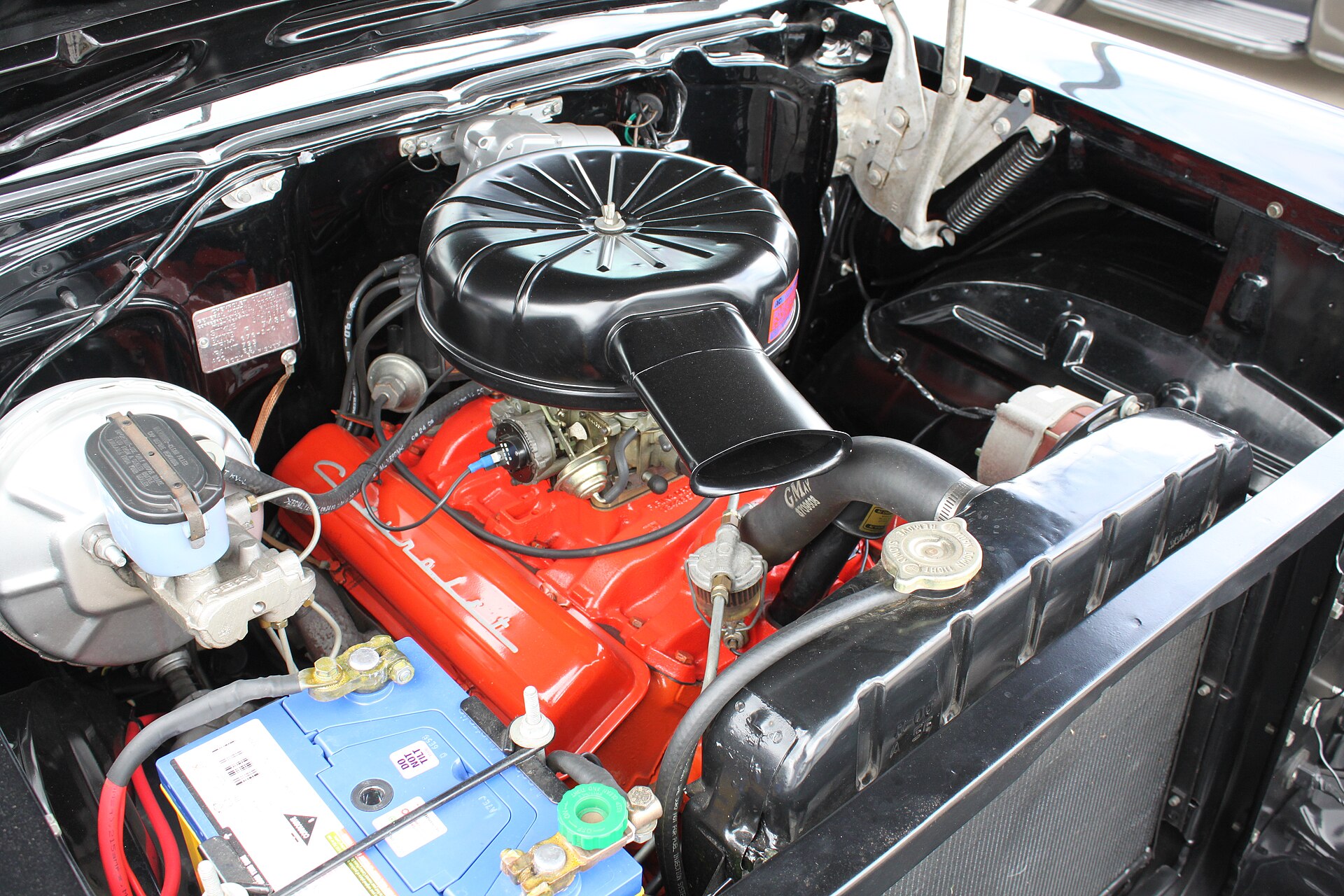
283 describes cubic inches, not an automatic promise of 283 horsepower. The ordinary two-barrel version was rated at 185 gross hp; the single four-barrel version at 220 gross hp. Chevrolet documented the 185 hp two-barrel with Powerglide. The reviewed records do not establish which combination sold most.
The extra displacement came through bore, not stroke: the 283-cubic-inch V8 used a 3.875-inch bore and a 3-inch stroke, against the 265-cubic-inch V8’s 3.75-inch bore and the same stroke. The 1957 range still included the 265-cubic-inch V8 and the 235.5-cubic-inch six. Reading “V8” as “283” skips a step the factory engine table does not allow.
Period gross ratings. Do not compare directly with modern net ratings.
The stroke stayed at 3 inches. A larger bore made the 283-cubic-inch V8.
One engine.
Two published ratings.
Chevrolet's own sheet lists gross and net brake horsepower. These are contemporary ratings, not conversions to modern SAE net figures.
Two-barrel 283
Sources & notes
Factory documents establish specifications and what Chevrolet claimed. They do not authenticate an individual surviving car.
- R17Specifications scan 44, dated October 29, 1956, date added March 1, 1957; bottom ADVERTISED MAXIMUM ENGINE PERFORMANCE table, first and last carburetion columns, peak brake horsepower gross/net rows. Open the cited document
Planetary gear ratios. Converter torque multiplication is a separate matter.
Read the March 1, 1957 specification sheet ↗The fuel-injection footnote.
Fuel injection belongs in the comparison, not on every V8 badge. The factory table lists injected 283-cubic-inch engines at 250 and 283 gross hp, alongside dual-four-barrel versions at 245 and 270 gross hp. The famous meeting of 283 cubic inches and 283 horsepower applies to one version. A hood V identifies the engine family, while a serial prefix answers another limited question. Chapter 09 separates those numbering systems; neither authenticates the present engine.
Two different routes to smooth.
Powerglide and Turboglide are different automatics. Powerglide has low and direct-drive forward ratios. Turboglide’s three turbines share torque through a changing converter relationship; the turbine count does not promise three successive forward shifts. The dated HR/GR lettering comparison is in the reading-room archive.
Underneath, Chevrolet retained the basic 1956 chassis layout with revisions to bracing and suspension details. Independent front control arms and coils worked with a leaf-sprung live rear axle.
Sources & notes
Factory documents establish specifications and what Chevrolet claimed. They do not authenticate an individual surviving car.
- F08S scan 13, Serial Identification, amended May 15, 1957. Chevrolet Specifications · dated 1956–57 sheets
- F15E p. 24. Chevrolet Engineering Features · October 1956
- F25E p. 71; S scan 34. Chevrolet Engineering Features · October 1956
- F26S scans 34–36; E pp. 71–72. Chevrolet Specifications · dated 1956–57 sheets
- F28S scan 44, amended March 1, 1957. Chevrolet Specifications · dated 1956–57 sheets
- F29S scan 44. Chevrolet Specifications · dated 1956–57 sheets
- F30S scan 44. Chevrolet Specifications · dated 1956–57 sheets
- F31S engine table scans 39 and 44. Chevrolet Specifications · dated 1956–57 sheets
- F32E pp. 76–79. Chevrolet Engineering Features · October 1956
- F33E p. 78; S scan 62. Chevrolet Engineering Features · October 1956
- R08S scan 61, revised March 1, 1957. Open the cited document
- R17Specifications scan 44, dated October 29, 1956, date added March 1, 1957; bottom ADVERTISED MAXIMUM ENGINE PERFORMANCE table, first and last carburetion columns, peak brake horsepower gross/net rows. Open the cited document
A year on the move.
- APRIL1957
Owners speak
Popular Mechanics publishes its Chevrolet owner survey.
- OCTOBER 41957
A signal from space
The Soviet Union launches Sputnik, the first artificial Earth satellite.
- NOVEMBER 11957
A new road across the straits
The Mackinac Bridge opens to traffic.
Before tax deductions · Census, December 1958 report
This is family money income before tax deductions, not one typical Chevrolet buyer’s wage. The Census report defines the median as the point separating the lower and upper halves of the distribution. It also cautions that higher money income need not mean higher purchasing power.
Ford, Chevrolet—and which count?
TIME’s August 25, 1958 table gives a specific answer: 1,655,068 Ford cars versus 1,552,471 Chevrolets for the 1957 model year. It measures production through model changeover and lists Thunderbird separately. Ford leads in that table. A calendar-year retail-sales comparison would need different evidence; “sales” and “production” are not interchangeable labels.
Sources & notes
Factory documents establish specifications and what Chevrolet claimed. They do not authenticate an individual surviving car.
- R09C P60-30 pp. 1–2. Open the cited document
- R10N NASA history, 65 Years Ago: Sputnik Ushers in the Space Age. Open the cited document
- R11MB Mackinac Bridge Authority, opening-date FAQ. Open the cited document
- R12T TIME, Business: Auto Production, August 25, 1958. Open the cited document
- F50PM pp. 108–111, especially 110–111. Popular Mechanics · April 1957, pp. 108–111
The owners had opinions.
The hood ornaments that make the car easy to recognize were not universally admired when it was new. In Popular Mechanics’ April 1957 Chevrolet owner survey, the dual hood ornaments led the least-liked exterior-feature table at 11.9%. The grille led the best-liked exterior table at 22.5%. These were separate questions; the figures are not two halves of a vote.
Chevrolet’s own brochure asked readers to notice the glass. It described the Sport Coupe as a hardtop and promoted increased windshield glass area. The Sport Sedan spread emphasized the open view without center pillars. That is a manufacturer’s sales promise, worth reading alongside the body illustrations. It is not an independent verdict on visibility from every seat.
Most-mentioned favorite exterior feature
Most-mentioned disliked exterior feature
Popular Mechanics · April 1957
Separate questions, not opposing shares of a vote.
The survey gives showroom language some resistance. Performance and acceleration headed the best-liked overall features at 44.4%; poor gas mileage led specific complaints at 15.9%. The magazine sent questionnaires to Chevrolet owners in 31 states. The published results do not provide a Bel Air Sport Coupe-only breakdown.
Nor does the table support a simple story that every buyer wanted longer and lower. It reports that 76.2% did not want the car longer, and 63.6% did not object to it being higher than competing makes. Those responses put a useful limit on the assumption that the showroom fashion spoke for all the people writing the checks.
For a closer look, compare the sales brochure’s body captions with a period advertisement. Read the model label before borrowing the headline: a Sport Sedan’s pillarless view and a Sport Coupe’s two doors are related, but distinct, stories.
Survey scope and sampling limits
Read these as reported responses, not a population poll. Sample size, percentage denominators and response bias remain unresolved in the reviewed pages. “Most frequently mentioned” does not mean a majority disliked the hood ornaments.
Sources & notes
Factory documents establish specifications and what Chevrolet claimed. They do not authenticate an individual surviving car.
- F49B scans 02–03. Chevrolet sales brochure · 1957, version A
- F50PM pp. 108–111, especially 110–111. Popular Mechanics · April 1957, pp. 108–111
- F51PM pp. 108,110. Popular Mechanics · April 1957, pp. 108–111
- F52PM pp. 108–110. Popular Mechanics · April 1957, pp. 108–111
- R23Popular Mechanics April 1957 survey opening map caption, OCR excerpt saved locally: `We sent questionnaires` and `31 states`; damaged OCR between these phrases is not copied as typeset quotation. Existing F50 establishes article identity and survey scope. Open the cited document
Familiar. But which ’57?
A familiar ’57 Chevrolet is not necessarily this Bel Air. The yellow Project X in The Hollywood Knights was a 210 post sedan, identified in a first-person account of the filming. In its 2020 exhibition story, the NASCAR Hall of Fame identifies its 1957 champion entry as a Chevrolet 150. Those connections belong to the wider Chevrolet family.
The quiz uses schematic profiles, not replicas of the film or race cars. Look first for the pillar, then for the trim panel. Choose the profile that illustrates the Bel Air Sport Coupe body and trim treatment.
Show all three identities
A: Chevrolet 150. B: Chevrolet 210 post sedan. C: Bel Air Sport Coupe. Profiles illustrate body and trim distinctions, not the appearance of a particular historic car.

Read the treatment shown.
An open hardtop window line rules out the post sedan, but not a 210 Sport Coupe. The fluted insert matches the Bel Air trim treatment shown. Apply that reading sequence to a model box, brochure illustration or car across a parking lot; manufacturing identity still needs evidence.
Sources & notes
Factory documents establish specifications and what Chevrolet claimed. They do not authenticate an individual surviving car.
- F01E pp. 10–12; B scan 03. Chevrolet Engineering Features · October 1956
- F03E pp. 10,14–19; S scan 17. Chevrolet Engineering Features · October 1956
- F14E p. 25. Chevrolet Engineering Features · October 1956
- F57PX, first-person passage, September 6, 2007.
- F58NH, Glory Road Champions,1957 entry.
A closer look pays off.
The model offering
Six-passenger Bel Air Sport Coupe. This model number alone does not specify a V8.
The body style
1957 Bel Air Sport Coupe: model year, series and body type in the Fisher style designation.
Engine family, series, year
V8, Bel Air, 1957. It does not identify body style or authenticate the present engine.
Sport Coupe or converted post car?
Begin with the factory body description, then separate body identity from trim identity. A 210 could have the Sport Coupe body too. Adding a Bel Air insert or removing an obvious pillar does not supply a documented manufacturing history.
Compare records of the identification plates with the appropriate original body documentation. The three numbering systems above answer different questions. Our sources do not establish a definitive converted-body weld or roof-rail checklist, so those structural questions belong with a qualified inspection.
Keep three records.
- 01Identity
What do the body, trim and documents establish?
- 02Condition
What can an inspection of the actual car establish?
- 03Changes
What was altered, when, and with what supporting record?
For a car you may buy, make three separate records: identity, condition and changes. Request clear photographs of the body structure, floors and underside, identification plates, engine and transmission, and accessory mountings. Ask the seller to distinguish documented work from recollection. Have a qualified inspector evaluate the actual car and any suspected structural alteration. A useful inspection describes evidence and remaining questions; it does not turn a nice photograph into a certificate of originality.
Use the details you have learned as questions to carry along. Is the quarter insert the documented fluted aluminum treatment? Does the color description distinguish Larkspur from Harbor Blue? Are the wheels stock-size or an acknowledged modification? Do the body and trim records agree with the story? Nominal factory dimensions and a paint chart help you ask informed questions. They cannot establish the condition of hidden metal or the quality of a past repair.
Sources & notes
Factory documents establish specifications and what Chevrolet claimed. They do not authenticate an individual surviving car.
- F01E pp. 10–12; B scan 03. Chevrolet Engineering Features · October 1956
- F03E pp. 10,14–19; S scan 17. Chevrolet Engineering Features · October 1956
- F04E pp. 10–11; B scan 02. Chevrolet Engineering Features · October 1956
- F08S scan 13, Serial Identification, amended May 15, 1957. Chevrolet Specifications · dated 1956–57 sheets
- F13E p. 24; S scan 26. Chevrolet Engineering Features · October 1956
- F14E p. 25. Chevrolet Engineering Features · October 1956
- F23E pp. 26,71. Chevrolet Engineering Features · October 1956
- F24E p. 44; S scan 17. Chevrolet Engineering Features · October 1956
- F40M p. 1133; S scan 31; E p. 25. Master Parts Catalog · paint chart, p. 1133
- F42S scan 31. Chevrolet Specifications · dated 1956–57 sheets
- R22Master Parts Catalog p. 677 explains STYLE number fields (model year, model series, body type); p. 678, 1957 column intersects BEL AIR and SPORT COUPE at 1037D; p. 679 places 1037D among two-door bodies. This primary evidence upgrades the earlier F07 hold. Open the cited document
There is always another detail.
Take a second pass through a photograph: read the window opening, quarter insert, headlamp mesh and hood ornaments. The three records below show how a small visible detail can lead to a more precise documentary question.
The engineering booklet explains design details; specification sheets establish nominal dimensions and equipment. Use the original documents when an identification needs to go further.
For color questions, keep the exterior paint chart beside the interior trim chart. Together they explain why different parts of the same blue car can carry different blues.
Small differences.
Better questions.
Open a record to see what the document establishes—and where the answer ends.
01 / HR or GR on the quadrant?
The October 1956 engineering booklet calls Turboglide's selection HR, Hill Retarder. The specification sheet revised May 15, 1957 shows GR, Grade Retarder. These dates establish different printed labels, not an exact production changeover.
Sources & notes
Factory documents establish specifications and what Chevrolet claimed. They do not authenticate an individual surviving car.
- F33E p. 78; S scan 62. Chevrolet Engineering Features · October 1956
02 / Bumper insert or accessory cushion?
Accessory cushion 987578 replaces the production bumper-guard insert. A bright bumper tip alone is not evidence of an incorrect surviving car.
Sources & notes
Factory documents establish specifications and what Chevrolet claimed. They do not authenticate an individual surviving car.
- R13A p. 88, accessory 987578. Open the cited document
03 / A viewer resting on the dashboard?
Sheet 987499 shows an arm and clevis, a threaded panel mounting, machine screw and retaining hardware. It also has a separate truck positioning sketch. This documents a mounted optical aid, not a loose lens.
Sources & notes
Factory documents establish specifications and what Chevrolet claimed. They do not authenticate an individual surviving car.
- R01A p. 201. Open the cited document
Research question: what did an equipped buyer pay?
What did a buyer actually pay? A base-price entry is not an equipped invoice. The engine and transmission description, accessory charges and the date of the document matter. We have not reconciled the Sport Coupe price summaries to a dated Chevrolet dealer sheet for the configuration discussed here. Consequently, this guide does not calculate a reassuringly precise “months of wages” comparison from an unverified car price and a family-income statistic.
How Chevrolet explained its design and mechanical changes.
Dimensions, equipment and dated amendments.
Exterior combinations and historical paint identifiers.
Mountings and parts behind those little luxuries.
Chevrolet’s own account of optional conveniences.
Popular Mechanics, April 1957: enthusiasm and complaints.
Sources & notes
Factory documents establish specifications and what Chevrolet claimed. They do not authenticate an individual surviving car.
- F01E pp. 10–12; B scan 03. Chevrolet Engineering Features · October 1956
- F08S scan 13, Serial Identification, amended May 15, 1957. Chevrolet Specifications · dated 1956–57 sheets
- F14E p. 25. Chevrolet Engineering Features · October 1956
- F15E p. 24. Chevrolet Engineering Features · October 1956
- F18E p. 23. Chevrolet Engineering Features · October 1956
- F19E pp. 23,45–46. Chevrolet Engineering Features · October 1956
- F23E pp. 26,71. Chevrolet Engineering Features · October 1956
- F24E p. 44; S scan 17. Chevrolet Engineering Features · October 1956
- F40M p. 1133; S scan 31; E p. 25. Master Parts Catalog · paint chart, p. 1133
- F41S scan 31 footnote; E p. 25. Chevrolet Specifications · dated 1956–57 sheets
- F42S scan 31. Chevrolet Specifications · dated 1956–57 sheets
Photographs & image credits
- hero · 1957 Chevrolet Belair 2 door Hardtop (21290142815)Sicnag, via Wikimedia Commons · CC BY 2.0Top and bottom background cropped; complete car retained. Resized and converted to WebP with JPEG fallback; no recoloring or retouching.License terms ↗Source & license ↗
- front detail · 1957 Chevrolet Belair 2 door Hardtop (21290142815)Sicnag, via Wikimedia Commons · CC BY 2.0Detail crop of the same accepted source photograph (2500, 1240, 2250 × 1710 source pixels); resized and converted. No recoloring or retouching.License terms ↗Source & license ↗
- quarter detail · 1957 Chevrolet Belair 2 door Hardtop (21290142815)Sicnag, via Wikimedia Commons · CC BY 2.0Detail crop of the same accepted source photograph (290, 1160, 920 × 650 source pixels); resized and converted. No recoloring or retouching.License terms ↗Source & license ↗
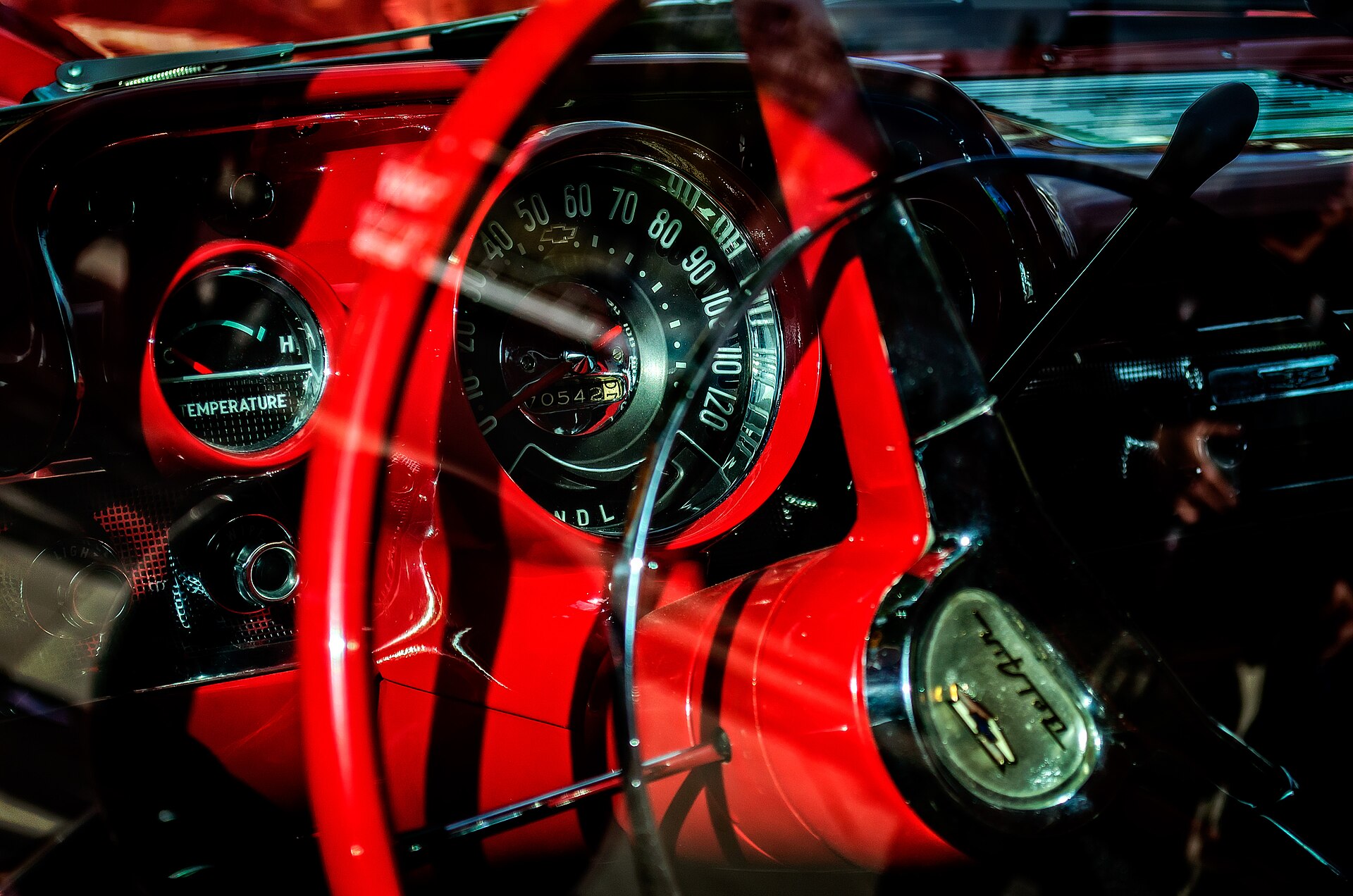
- dashboard blue · Chevrolet Bel Air 1957 Ebern 2019 6200535.jpgErmell, via Wikimedia Commons, CC BY-SA 4.0 · CC BY-SA 4.0Unmodified Wikimedia rendition (1920 px wide); no crop, color change, or retouching.License terms ↗Source & license ↗
- instrument cluster · Vintage Classic Car Boot Sale 2013 - 04.jpggarryknight, via Wikimedia Commons, CC BY 2.0 · CC BY 2.0Unmodified Wikimedia rendition (1920 px wide); no crop, color change, or retouching.License terms ↗Source & license ↗
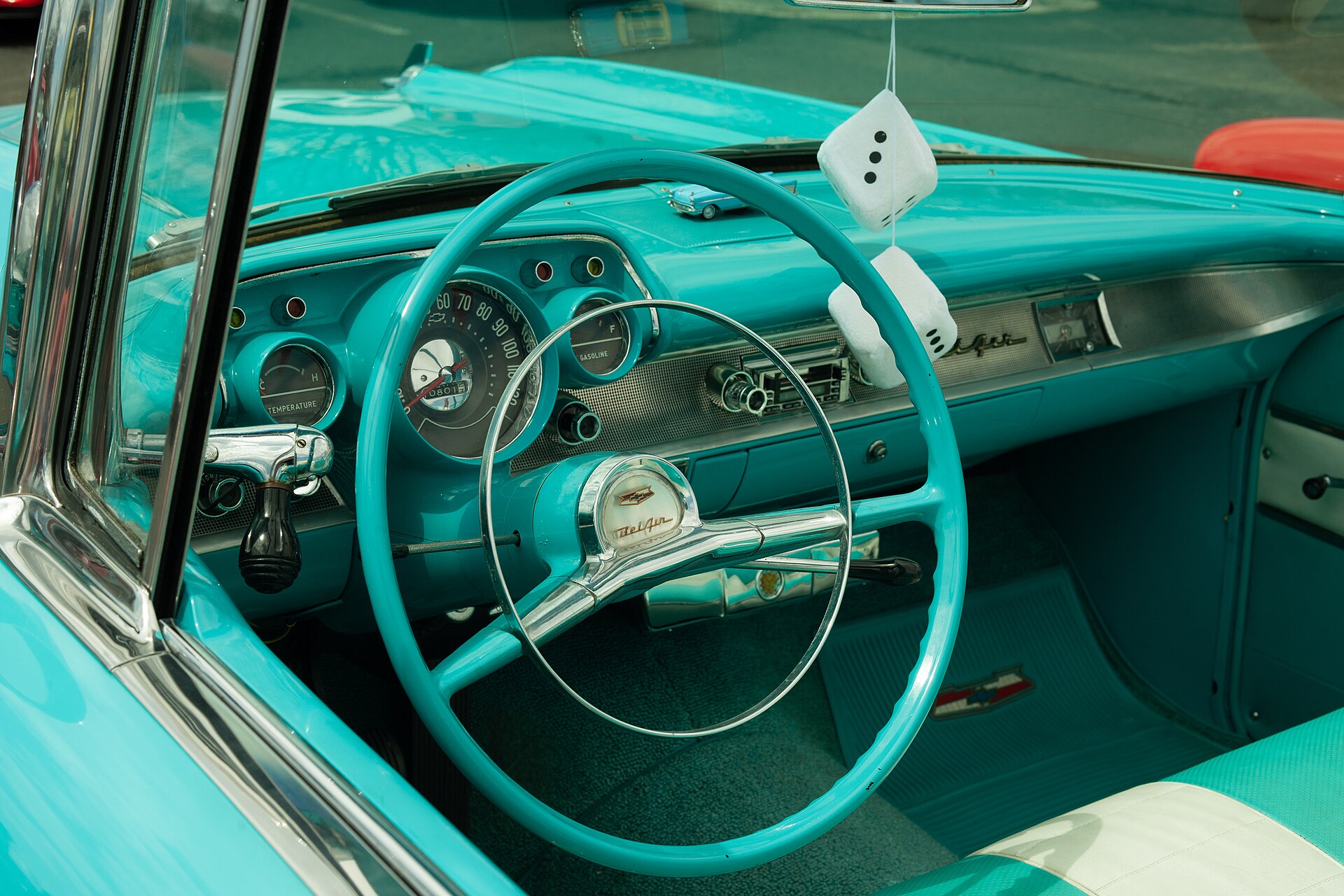
- cabin controls · 57chevyinterior.jpgBUTTON74, via Wikimedia Commons, CC BY-SA 4.0 · CC BY-SA 4.0Unmodified Wikimedia rendition (1920 px wide); no crop, color change, or retouching.License terms ↗Source & license ↗
- hood ornaments · Chevrolet Bel Air Leimershof -20190907-RM-165647.jpgErmell, via Wikimedia Commons, CC BY-SA 4.0 · CC BY-SA 4.0Unmodified Wikimedia rendition (1920 px wide); no crop, color change, or retouching.License terms ↗Source & license ↗
- headlamp louvers · Chevrolet Bel Air pic1.JPGAlf van Beem, via Wikimedia Commons, CC0 · CC0Unmodified Wikimedia rendition (1920 px wide); no crop, color change, or retouching.License terms ↗Source & license ↗
- fin quarter · Finsational 57 Bel Airs (9130406952).jpgGreg Gjerdingen from Willmar, USA, via Wikimedia Commons, CC BY 2.0 · CC BY 2.0Unmodified Wikimedia rendition (1920 px wide); no crop, color change, or retouching.License terms ↗Source & license ↗
- fin detail · Fins Baby (9577122354).jpgDamian Gadal, via Wikimedia Commons, CC BY 2.0 · CC BY 2.0Unmodified Wikimedia rendition (1920 px wide); no crop, color change, or retouching.License terms ↗Source & license ↗
- engine bay · 1957 Chevrolet Bel Air (24016213283).jpgJeremy from Sydney, Australia, via Wikimedia Commons, CC BY 2.0 · CC BY 2.0Unmodified Wikimedia rendition (1920 px wide); no crop, color change, or retouching.License terms ↗Source & license ↗
The cover photograph shows a surviving Sport Coupe. Its paint code, cabin accessories and mechanical specification are not authenticated here. Body, ventilation and color-placement diagrams explain the factory documents; screen colors are approximate.